
Invasive Species Management
Early detection. Rapid response.
A large part of protecting land revolves around detecting, monitoring, and responding to invasive species. Throughout each season we focus on different invasive species including terrestrial and aquatic plants and animals.
Our work expands through education. We invite our community to take action by volunteering with us, consulting with us, and being more intentional with the spaces they have influence over.
Aquatic Invasive Species (AIS)
Early detection & rapid response
Chautauqua Lake supports a wide variety of aquatic plants. The lake’s underwater flora includes rare, threatened species as well as a variety of common plants that provide essential habitat for fish and other animals and aid in maintaining water quality. However, it also includes several non-native invasive species that can cause challenges for the lake’s ecology, limit recreational activities, and impact the local economy.
Some of these invasive aquatic species, such as curly-leaved pondweed and Eurasian watermilfoil, have been present in Chautauqua Lake for many decades and have become established, needing regular management locally to control their population density. Others, such as water chestnut, starry stonewort, or brittle naiad, are relative newcomers that have the potential to spread explosively if ignored. They require varying degrees of monitoring and removal efforts to keep them in check.
In addition, a handful of new aquatic invasive species that are known to occur in nearby lakes and waterways but which have not yet been found in Chautauqua Lake, have the potential to arrive here on boats and fishing gear that isn’t properly cleaned. Such aquatic hitchhikers can potentially create new problems for our lake, especially if they go undetected for too long.
To address this, Everwild Land Trust runs an Aquatic Invasive Species (AIS) Early Detection program each summer. Trained staff and dedicated volunteers monitor the lake, survey for invasive species, and remove them when found. Regular “on-water classroom” [link] sessions are offered to train new volunteers in identifying target species and report sightings through iMapInvasives, helping us increase awareness and improve coverage throughout the busy summer season.
In addition, our staff leads the collaborative control efforts carried out together with local non-profit and municipal partners that combat the fast-spreading alga starry stonewort. Using innovative pilot removal efforts, which include Diver Assisted Suction Harvesting (DASH) and the deployment of specialized harvesting equipment, we attempt to find an effective control method for this new invasive. Simultaneously, we continue our successful, volunteer-driven removal of water chestnut in the lake’s outlet.
Besides coordinating early detection and rapid, targeted responses to the arrival of new invasive species threats, Everwild Land Trust staff is also restoring native underwater plant communities in areas where they have been compromised. In 2025, nearly 2,000 native eelgrass plants were installed in cleared areas where starry stonewort was removed to help stabilize lake bottom sediment, improve habitat quality, and make it harder for invasives to return.
While aquatic invasive species remain a serious challenge, coordinated action by Everwild Land Trust, partner organizations, and dedicated volunteers is making meaningful progress toward a healthier, more resilient Chautauqua Lake.
.jpg)


.webp)
Invasive Plants
Educating & offering beneficial alternatives
A plant is considered invasive when it is not native to the region and its introduction results in economic harm, environmental harm, or harm to human health. These plants tend to grow and reproduce quickly, often spreading to the point of disrupting and displacing native plant communities or ecosystems. Invasive plants that evolved in other parts of the world or were cultivated by humans into forms that don’t exist in nature do not support wildlife as well as native plants. Many have escaped into our natural areas and have become invasive exotics that have destroyed and taken over our natural habitat. While there are many ways that invasive plants are transported to new areas, humans have become one of the largest contributors. We have equipped many of our preserves with boot brushes to help stop the spread and urge all of our preserve visitors to be cautious in not spreading unwanted plants. Everwild Land Trust places a heavy emphasis on invasive species prevention and management both in our preserves and other areas in the region. Additionally, through our Yard Smarts program, we are able to help landowners learn how to deal with issues related to invasive species on their own properties.
The top five invasive plants you are likely to see in your yard in or around Chautauqua County are Japanese Knotweed, Asian Bush Honeysuckle, Purple Loosestrife, Multi-flora Rose, and Norway Maple. Unfortunately, some local nurseries still sell ornamental garden plants that are considered invasive and potentially harmful to the environment. A few of those plants, and alternative native choices, are:
• Instead of a Norway Maple, consider a Sugar Maple or Red Maple
• Instead of a Burning Bush, consider a Virginia Sweetspire or Bush Honeysuckle
• Instead of a Chanticleer Pear, consider a Serviceberry
• Instead of a Butterflybush, consider a Butterflyweed or Swamp Milkweed
• Instead of a Yellow-Flag iris, consider a Blue-Flag IrisOur region is also home to many wonderful native plant nurseries that specialize in species that are local.
For more information regarding invasive species in our area, visit:
Tree of Heaven & Spotted Lantern Fly
A dangerous duo
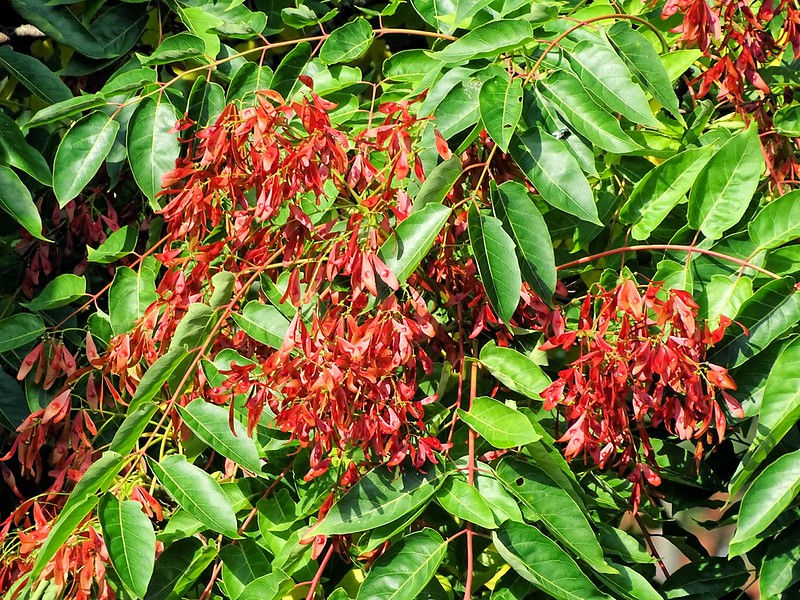
Tree-of-heaven (Ailanthus altissima) may sound benign, even heavenly, but this fast-growing invasive tree poses a serious threat to our local ecosystems. Originally from China, it thrives in poor soils and harsh conditions, quickly dominating disturbed areas like riverbanks and urban edges. Even more concerning, it releases chemicals that prevent other plants from growing nearby, creating near-monocultures that crowd out native vegetation. Attempts to remove it can backfire if done improperly, as cutting a single tree often triggers a surge of aggressive root sprouts, making control difficult without a strategic, long-term approach.
This species is also the preferred host for the destructive Spotted Lanternfly (Lycorma delicatula), an invasive insect that is rapidly spreading across the eastern United States. By feeding on sap, lanternflies can damage crops like grapes and apples and leave behind sticky residue that fosters mold growth, impacting both agriculture and public spaces.
Since 2022, our staff has led targeted efforts to remove all Tree-of-Heaven from the Chadakoin River corridor in Jamestown, where these trees abounded. By removing dense concentrations of this tree, which acts as a Spotted Lanternfly “magnet”, we hope to keep both pests at bay.
A few Tree-of-Heaven “sentinels” were purposely left untouched and those are outfitted with specialized traps and checked routinely for the presence of Spotted Lanternflies throughout each summer. To date, more than 3,500 of the invasive trees have been removed and no Spotted Lanternflies have been detected.
Restoration efforts to restore the vegetation along the river’s banks are ongoing important bank are already underway to map and eradicate Tree-of-heaven stands as part of a broader restoration initiative. Through careful treatment, ongoing monitoring, and replanting with native species, this proactive work aims to protect the river corridor—and our regional economy—from a costly and potentially devastating invasion.
-1744-TwanLeenders%20copy.jpg)
Hemlock Woolly Adelgid (HWA)
Monitoring as prevention & protection
Everwild Land Trust has been conducting yearly Hemlock Woolly Adelgid (HWA) surveys on our preserves and other local hemlock stands for over a decade.
HWA is a small aphid-like insect that feeds on hemlock trees, ultimately killing the infected trees that go without treatment. They are easily identifiable by their white “woolly” masses that are typically visible throughout the year. These invasive adelgids are transferred from tree to tree most often by birds, but other modes of transmission are possible as well, including via humans. Once the adelgids land on the host tree, they will remain in the same spot for the rest of their lives, continually feeding and developing into adults. Their feeding is extremely harmful to the canopy of the host tree as it disrupts the flow of nutrients to the twigs and needles of the infected tree. After becoming infected, host trees typically die in four to ten years.
Our surveys take place in January through mid-March since HWA is most visible in winter and the risk of spread is lower. HWA is quite unique in that during the coldest months, the insects are actively feeding until they begin to produce eggs in early spring. The juvenile HWAs that develop from the eggs are known as crawlers, and it is at this stage that the risk of spread is exponentially increased. HWA is moving into our area very quickly and raises a large concern for hemlock populations in our area. By surveying local hemlock trees and reporting any HWA we observe on them, we can help with the implementation of targeted treatment plans to manage the infestations and prevent further spread. Each year, we hold multiple public surveys, in addition to our private surveys, in order to educate the public on how to spot and report HWA. If you spot HWA, remember not to touch or move infected branches, but please record the GPS coordinates or general location, take a picture of the sighting, and report your findings to your local management office.
If you spot HWA:
• Do not touch or move infected branches.
• Record the GPS coordinates or general location.
• Take a picture of the sighting.
• Report your findings to your local management office.
Everwild Land Trust
71 East Fairmount Ave.
Lakewood NY 14750
info@everwildlt.org
(716) 664-2166
Western New York PRISM
1300 Elmwood Ave.
Buffalo, NY 14222
wnyprism@buffalostate.edu
(716) 878-4708
wnyprism.org
NYSDEC
invasive species coordination
(518) 402-9425.jpeg)
.jpg)